The trend of crypto projects(especially infras) listing at mammoth fully diluted valuations (FDV) with tiny circulating supply prevails into the second half of 2024
The disparity between market caps and fully diluted valuations (FDVs) has broadened significantly over the last 3 years
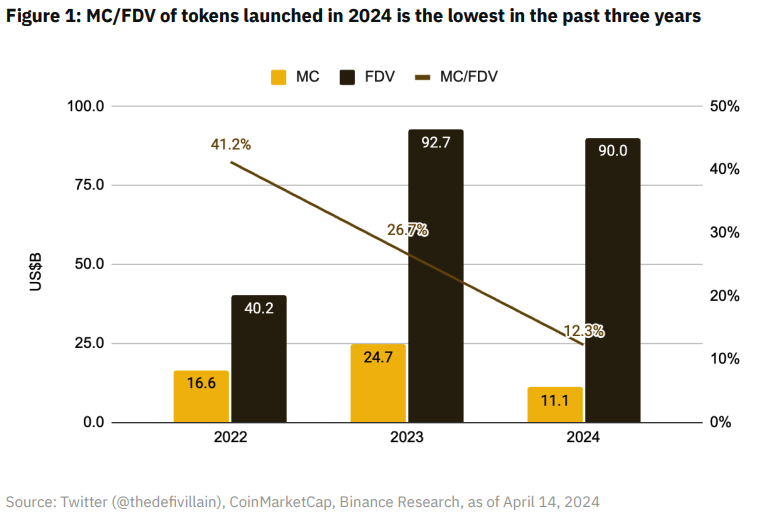
Launching with a low circulating supply/float allow projects to list at an arbitrarily high valuation – limited sell pressure (as most of token supply is locked), and easier to prop up the price (due to the thin liquidity)
The trend was driven by a massive influx of private venture capital, bidding up valuations of private companies, leading to astronomical valuations at listing
The disproportionate amount of private capital inflow vs no. of quality talents (builders/founders) in the space drives up the market valuations
This phenomenon of launching tokens at high FDV favors crypto projects as they get to spend hundreds of millions worth of tokens on airdrop campaigns to acquire users, as well as VCs where they get to bank out on the inflation of the valuations and token prices
But listing at high FDV translates into a limited upside for retail/public investors, greatly reducing the risk-reward for participating in public sales or purchasing the tokens on the secondary market post-listing. Essentially, retail investors become the exit liquidity for VCs or airdrop farmers
The recent launches of high FDV projects have been unsatisfactory. Consider the most recent 15 projects listed on Binance – 3 out of 15 projects managed to keep the token price trading at above the day 1 closing price, the rest simply trade on average 52% below.

Naturally, none of the projects managed to create new ATH after day 1 of listing, for obvious reasons – supply (selling from airdrops & private round investors) outweigh the demand (buying from retails post-listing) for the tokens
Over time, retail investors have caught on to this trick and are getting wise to the idea of becoming exit liquidity. Participating in IEO/IDOs pre-TGE may still yield profits, but buying the tokens post-TGE seems to be a negative EV play
Here comes the question – how much longer could the high FDV, low float meta last?
From 2024 onwards, $155B of locked tokens will be vested over the next 6 years, not to mention new infra projects that will be listed in the coming months with tokens pending unlocked
For now, a lot of the blue-chip projects depend on VCs/liquid funds and OTC shops to soak up on the unlocks, but for the longer tail tokens, finding bidders seems impossible. Hence we see many follow a “pump and dump to oblivion” chart pattern as tokens are gradually unlocked and distributed into the market
That said, it wouldn’t be a surprise to see the market ditches the old meta and gradually trends towards a “Low FDV, High Float” model – where tokens are launched at a lower valuation allowing retails to capture more upside, while airdropping a larger portion of tokens to increase the circulating supply to allow for more organic price discovery. But the downside of this is perhaps overpaying the early users.
Expect in the coming months centralized exchanges to favor listing of applications (which would typically launch at a lower valuation) that have found product-market-fit over infras that are really “empty highways” that no one uses.
Listing at lower valuation underpinned by better fundamentals & growth metrics with active users will be the way to go
Also see a clear path to adoption for non-transferrable token (as pioneered by EigenLayer for its $EIGEN token) – rewarding early users with non-transferrable tokens anradually unlocking them as the project reaches certain decentralization (achieving decent float distribution) and product (finding solid pmf and accumulating enough users) milestone. This way, the supply and demand imbalance shall be alleviated at the time tokens become transferrable, and token price will hopefully follows an organic price discovery towards the upside should the product gains more adoption
 Richard's Website