Some random thoughts from the week-long conference:
1/ Intents
- “Intent” isn’t something new – the concept has evolved from settling trades on a single chain (e.g. CoW Swap – multi-order batch auction & UniswapX – single order dutch auction) to settling trades across various chains and enabling better intents execution and settlement
- As the L2 ecosystem/ app chain narrative grows, users call for fast & cheap solutions to settle transactions cross-chain, hence we see a “Cambrian Explosion” of projects leveraging various techniques to achieve cross-chain intents
- The intent stack can be dissected into 3 main layers – Order Flow Interface (interfaces where users submit transactions (aka intents), Order Flow Auction Platforms (platforms that auction/route intents to solvers) and Solver Networks (operators that compete in order flow auctions to settle intents)
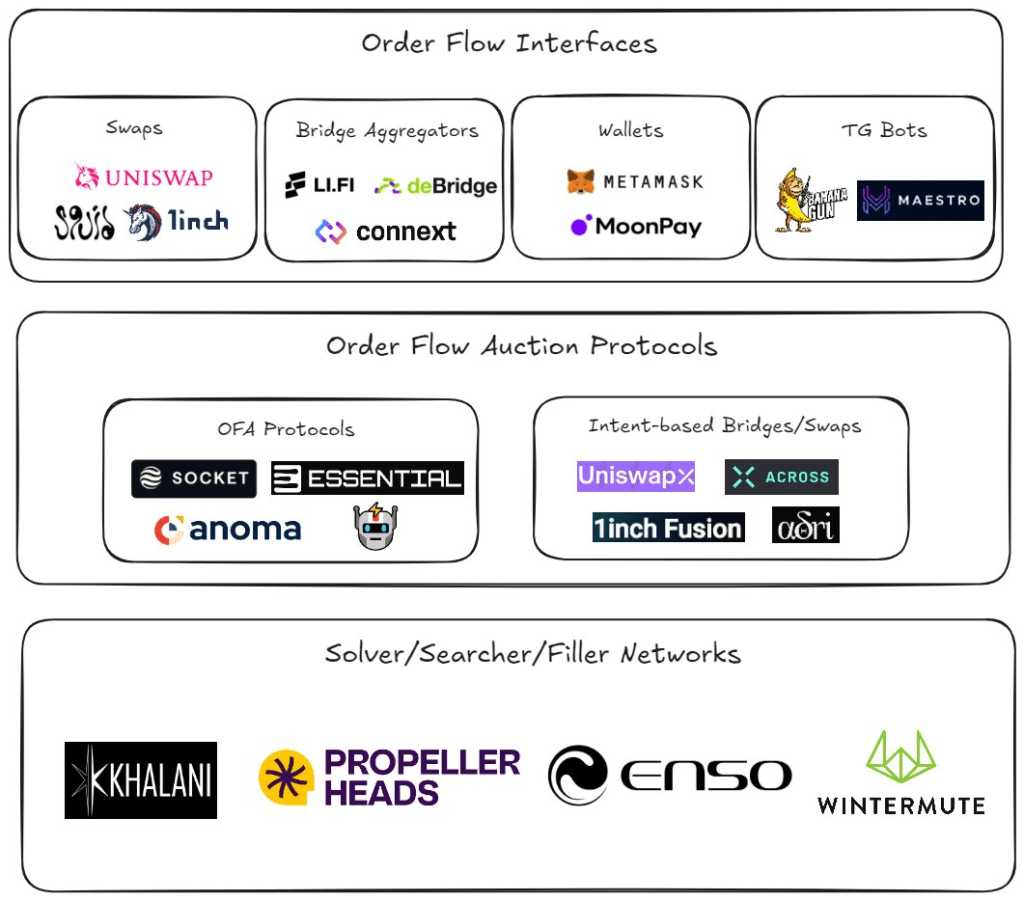
Some areas builders and researchers focused on refining:
- Intents abstraction to define user intents and actions
- Intents execution with AI agents to achieve optimal order routing and execution
- Cryptographic commitments of intents to mitigate MEVs extraction
- Intent-centric blockchain architecture to enhance security and efficiency of intent executions
2/ MEVs
Innovations/ on-going research now surround a few main directions – the mitigation of MEVs by implementing privacy designs, fair distribution of MEVs captured with viable economic models to align incentives of validators and users, provably fair order flow auction models to prevent centralization issues
Some research area seeing most contributions and mindshare:
- MEV-resistant mechanism design: for e.g. (i) same-block inclusion lists, (ii) deterministic ordering, and (iii) leaderless / no last mover
- Implementation of Trusted Execution Environment (TEEs), Multiparty Computations (MPC) and FHE in the design of private mempools and order flow auctions
- Implementation of private mempools & protected order flow
- Distributed block building
- Cryptographic commitments and proofs to mitigate MEVs extraction
- Threshold encryption + protocol-owned block builders
3/ TON ecosystem
- TON remains a hot ecosystem with the recent traction – TVL grew from $14m in Jan to $760m in July (5,400% increase); developer activities surged 3X since early this year; token price of $TON continue to trade near its ATH at fdv of $30bn with decent trading volume (24H vol of $550m); click/play-to-earn games like Hamster Kombat onboarding 200M registered users and Catizen doing 4.2M on-chain transactions from its 1.5M daily active users; trading bots like Banana Gun facilitating $20m average trading volume etc.
- The general bull thesis – gateway to onboarding more users from Web2 by offering fun & easy-to-use applications, abstracting away the clumsy crypto user experience through Telegram’s interface
- See growing interests from founders looking to build on TON – hyper-casual game platforms, DeFi protocols, even EVM-compatible L2s, raising capital at a valuation between the range of $20-50m
- Good to see growing developer interests but not a lot of projects are investable atm – especially TON native projects. Mostly are opportunistic teams flocking to the ecosystem for VC money
- Also note that most Telegram applications has little to do with the TON blockchain aside from the tokens. Most are simply distributing products through Telegram’s interface – e.g. Banana Gun offering its trading bots for trading tokens on Solana, Ethereum, Base, or UXUY wallet offering its gas-less P2P payment services settled on Lighting Network etc.
- Most activities we see from the TON ecosystem merely exists on the Telegram interface, but not on the TON blockchain.
- The challenge ahead will be converting these users to the native applications (e.g. DeFi apps) and create value to retain them
4/ Prediction Markets
- The recent success of Polymarket has stirred up a lot of interests in the prediction markets segment from builders and investors
- Polymarket recently crossed $1bn in betting volume. In July alone, $387m in bets were placed on various markets with US presidential election and ETH ETFs contributing most of the volume. Its user base grew 3 times since May to around 30k
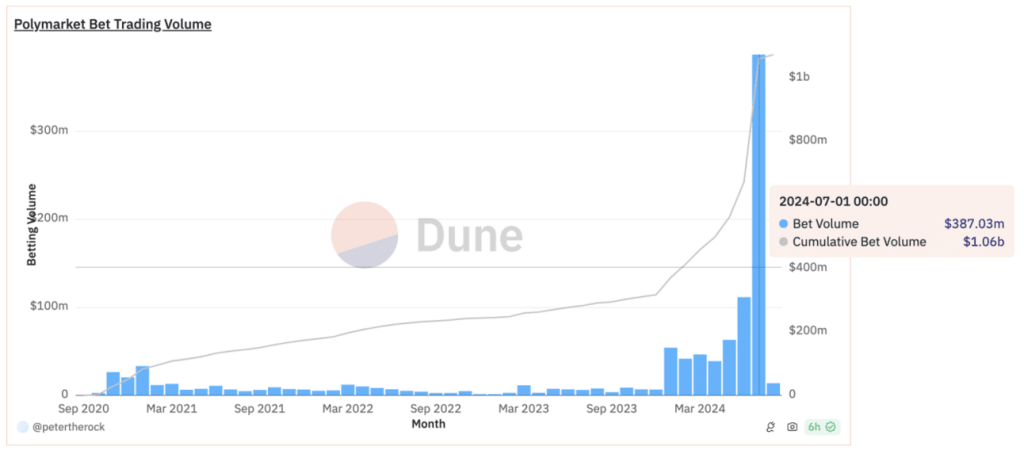
Polymarket was able to attract a good number of users/betters from Web2 by abstracting away the complicated blockchain user experience – leveraging Safe’s Smart Account (account abstraction) for easy onboarding & frictionless UX and settling transactions on Polygon PoS
VCs that missed out on Polymarket are now looking for the next horse in the prediction markets segment. We already see 10+ teams raising for their “Polymarket-fork” on L2s or alt L1s with their respective innovation
Some key new “add-ons” they sell: introduction of liquidity vaults as market making engine for bets to reduce costs of protocol incentives payout; improving on the DeFi composability of betting products to increase ROI for betters, adding “parlay” mechanism to attract betting volume, to name a few
Future direction for the segment would be to convert existing betters into other markets that open up more “regular” events for betters to participate in – sports, e-sports, fantasy sports and even events in financial markets. These will eventually be the main focus for prediction markets
Also note the hostile stance of centralized exchanges in terms of listing tokens of this segment but we shall see more clarity when Polymarket goes TGE
5/ Declining Valuations of Token Launches
- Beginning to see more consensus around abandoning the “high FDV, low mcap” launch strategy. Projects’ valuation at TGE is gradually coming down
- The highly-anticipated DA project Avail that went TGE on July 23rd turned out underperforming on the market’s expectation
- Pre-market trading on Aevo was pricing $AVAIL at $6bn+ in June vs launching at merely $2bn at TGE in July (a 66% drop), and now token is only trading at $1.5bn
- What’s more – it’s surprising that the project with such publicity was not able to get listed on top exchanges like Binance & OK. This goes to show that exchanges no longer favor listing of big names with minimal “real” traction
- The strategy of launching at high FDV for the sake of doing massive rounds of airdrops will no longer work
- THE WAY FORWARD → launch at lower FDV, enable organic price discovery
- The two highly anticipated high throughput/ parallel EVM chains – MegaETH & Monad are competing to go live by EOY
- An interesting strategy MegaETH will adopt is to raise less from private investors/VCs, launch the token at a lower valuation and let the market bid up its price
- From my conversations with peers in the VC circle – most are speculating that Monad’s token will launch at $5-10bn (~1.5-3X from last round), bear case $3-4bn if market condition turns bad. Say if MegaETH launches at $500m (which is ~2X from last round’s val), would expect retail to arbitrage the valuation against Monad’s – which could be a 6-15X upside for retails who buy in on day 1 of listing
- This will likely create a wealth effect as we see from Solana in its early days. The community enjoys a decent upside and sticks with the ecosystem – accelerating the ecosystem growth with active provision of TVL and participation in dapps
- On the other hand, upside for Monad seems limited considering the FDV of alt L1/L2s with similar on-chain activities are mostly trading at the range of $5-10bn (Sui at $8.4bn, Aptos at $6.5bn, Optimism at $5.7bn, Arbitrum at $5.4bn etc.)
- Would be interesting to see how this dynamics will play out towards end of the year
- Sidenote – on the primary market side, we’re also seeing a slight decline in valuations of seed stage projects to around $15-30m
6/ EigenLayer’s Hype Faded
- Retails lost interests since the announcement of the non-transferrable token airdrop and turns out the airdrop game is still dominated by whales (see GCR pulling ETH right after snapshot was taken)
- Vitalik calling out EL for its “high systemic risks” of restaking
- More competitions coming – Symbiotic, Karak etc.
- VCs no longer price AVSs at a premium, for few reasons: – doubts over how much of the economic security is needed – intersubjective restaking even doubles the supply of economic security – now you have 18B of ETH and 18B of EIGEN looking for yield – oversupply of economic security drives down the yield to AVSs now EL has to force more AVSs to launch in order to prop up the demand for security budget & build financial primitives on top of LRTs to source additional yields – which means there’s gonna be a long list of pipeline AVSs “vaporware” launching in the next 3 – 6 months
- The old way of pricing AVSs according to the amount of economic security bootstrapped also proves to be a fallacy – consider Altlayer trading at $3.6bn fdv with around$4bn economic security in early May (1:1) vs now trading at $920m with $2.6bn of economic security (1:3) – or Automata trading at $200m fdv with 2.5bn security value in May (1:12) vs now trading at $70m fdv with $4.6bn of economic security (1:65)
- Another thing to note is the nominal economic security value of each AVSs is “heavily inflated” as they’re sharing the same restaked ETHs with other AVSs
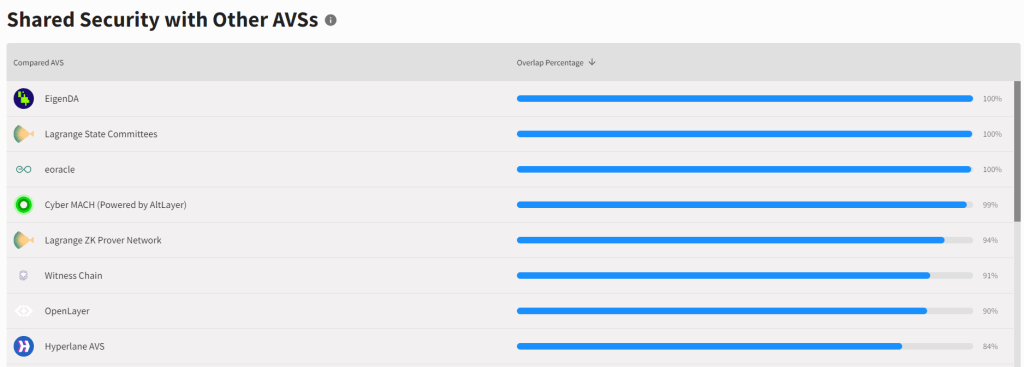
- That said, curious to see how EL will monopolize on getting top AVSs that have high organic demand for security AND deep financialization of the EL ecosystem by enhancing the composability of LRTs in DeF
7/ CeDeFi getting more mindshare
- Had a long chat with a friend who was invited to an exclusive interbank blockchain conference where they announced recent progress of their interbank settlement network building on Hyperledger’s stackVolume done and settled every month on the blockchain reached $1.5 trillion
- You read that right – $1T TRANSACTED AND SETTLED EVERY MONTH ON A BLOCKCHAIN
- What’s even more exciting – the banks are exploring ways to settle on permissionless blockchains like Ethereum – resilience of permissionless chains is far more superior than private chains
- At this point, fixating focus on crypto-native projects and disregarding infrastructure building in the intersection of crypto and financial institutions is probably not ideal
Subsectors we’re paying attention to:
- RWAs & Tokenization – platforms that resourcefully tokenize high quality yield-generating tradfi assets (fixed income products, real estates) and distribute globally on-chain in a regulatory compliant manner
- Privacy & TEEs – projects that make use of Trusted Execution Environments to create a secure and privacy-enabled avenue for financial institutions to conduct transactions on-chain (e.g. confidential smart contracts, secure key management, regulatory compliance with privacy, zkp on TEEs etc.)
 Richard's Website