Crypto projects thrive on network effects – where its token value increases as more users join the network.
Yet, a common misconception I still see with founders is the skewed focus on the product development, with the belief that “a great product will naturally attract users.”. This misconception has led many to create solutions for imagined problems, disconnected from their target audience’s perceived needs.
A functional product is essential for market entry, but the critical question founders should ask is: How do I get the community to rally around and champion my vision?
As we entered an era of progressive innovation, rather than zero-to-one innovation, new crypto products will only offer marginal improvements on user experience. We no longer see the groundbreaking DeFi innovation akin to the inception of AMMs in DeFi Summer in 2021. Instead, we’ll see things like: new AMM that introduces a new algo with a 2-5% better slippage, lower fees, improve LP efficiency, reduce impermanent losses; or a new L1 that allows higher throughput, quicker settlement, cheaper gas. But to users, these are simply marginal improvements so insignificant that they wouldn’t perceive as an issue. This highlights a distribution challenge: users won’t care until you make them care.
Take Apple’s iPhone as a Web2 parallel. Since 2007, 16+ iterations have introduced slight upgrades (e.g., better cameras, AI features). Yet, Apple’s success isn’t about product superiority—it’s about building a cult brand synonymous with innovation. This “brand effect” creates a self-reinforcing “CULTure”, driving annual upgrades. For crypto founders, the lesson is clear: distribution is the single most important moat.
Your product must innovate—whether it’s a cost-effective transaction layer or a narrative-shifting concept. But success hinges on how you distribute it.
Movement Labs exemplifies this with its MoveVM L2, not the first altVM (e.g., Eclipse’s SVM predates it), but a masterclass in distribution. They crafted a distinctive brand, leveraged memetics, and built community months before their token generation event (TGE), creating a narrative that outshone technical peers.
At times where new projects/narratives emerge every other week, attention spans are fleeting. They move on to the next shinny names once they’re done with your token. The importance of building a strong cult becomes more significant than ever.

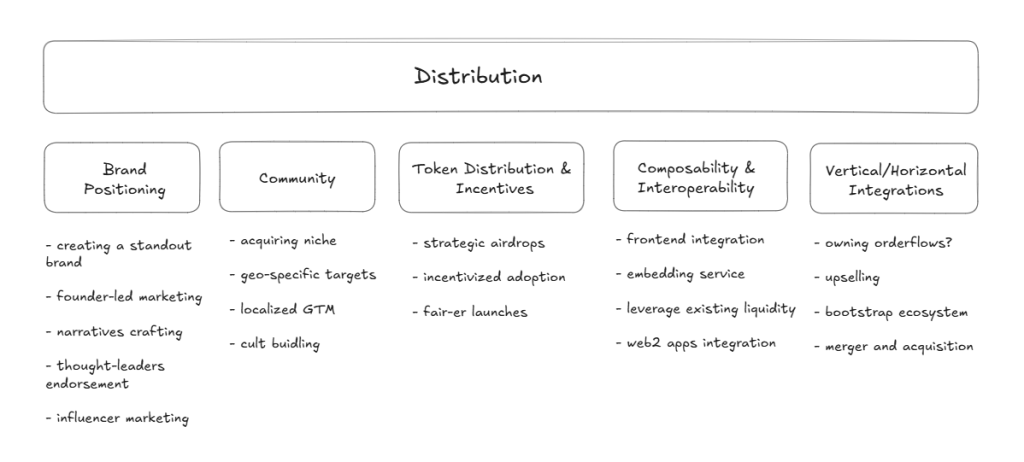
The best teams always prioritize the planning for their distribution, especially around their brand positioning. It’s about designing a unique brand DNA and building a “CULTure” around it. Monad’s brand DNA revolves around inclusivity, technical excellence and grassroots decentralization that fosters a playful, community-centric future; whilst MegaETH’s brand is deeply tied to a bold, rebellious and performance-obsessed persona that boasts exclusivity and curated innovation. Both had a distinctive approach towards the way they want to appeal to developers, but one thing in common was they began community building MONTHS before their TGE happen.
This is how most projects would prioritize the marketing and distribution efforts. Building in stealth, blindly focus on building its product with minimal resources spent on building an identity. Then within weeks before TGE, they would start pumping money to run all kinds of pointless marketing campaigns – another airdrop/giveaway, another paid shill campaign, another points program/stake to win. Results? Thousands of mercenary users come for the short-lived hype and be gone before you know it.

The best teams on the other hand would emphasize on establishing an identity that appeals to developers and users, selling a strong vision and preaching the significance of the product, creating a feedback loop from the community. And this often happens months, if not years, before TGE. What you’ll get is a community with strong conviction and they’ll become the most vocal advocates at & post TGE.

“First time founders are obsessed with the product, second time founders are relentless with distribution”. It’s time to rethink your priorities.
 Richard's Website
Leave a comment